LinkedIn's own data shows that a company's employees have, on average, 10 times as many connections as a company page has followers. Getting your team to post is one of the best ways to grow your brand's reach.
LinkedIn used to give companies a built-in way to get employees sharing. Then it took that away. The My Company tab, the Employee Advocacy tab, and the Curator admin role started disappearing in November 2024 and were fully gone by January 2025.
Programs that ran on those features now need a third-party LinkedIn employee advocacy tool to build a successful advocacy program. Without a tool, most teams fall back on Slack messages full of links. Nobody knows who posted, and leadership never sees a number.
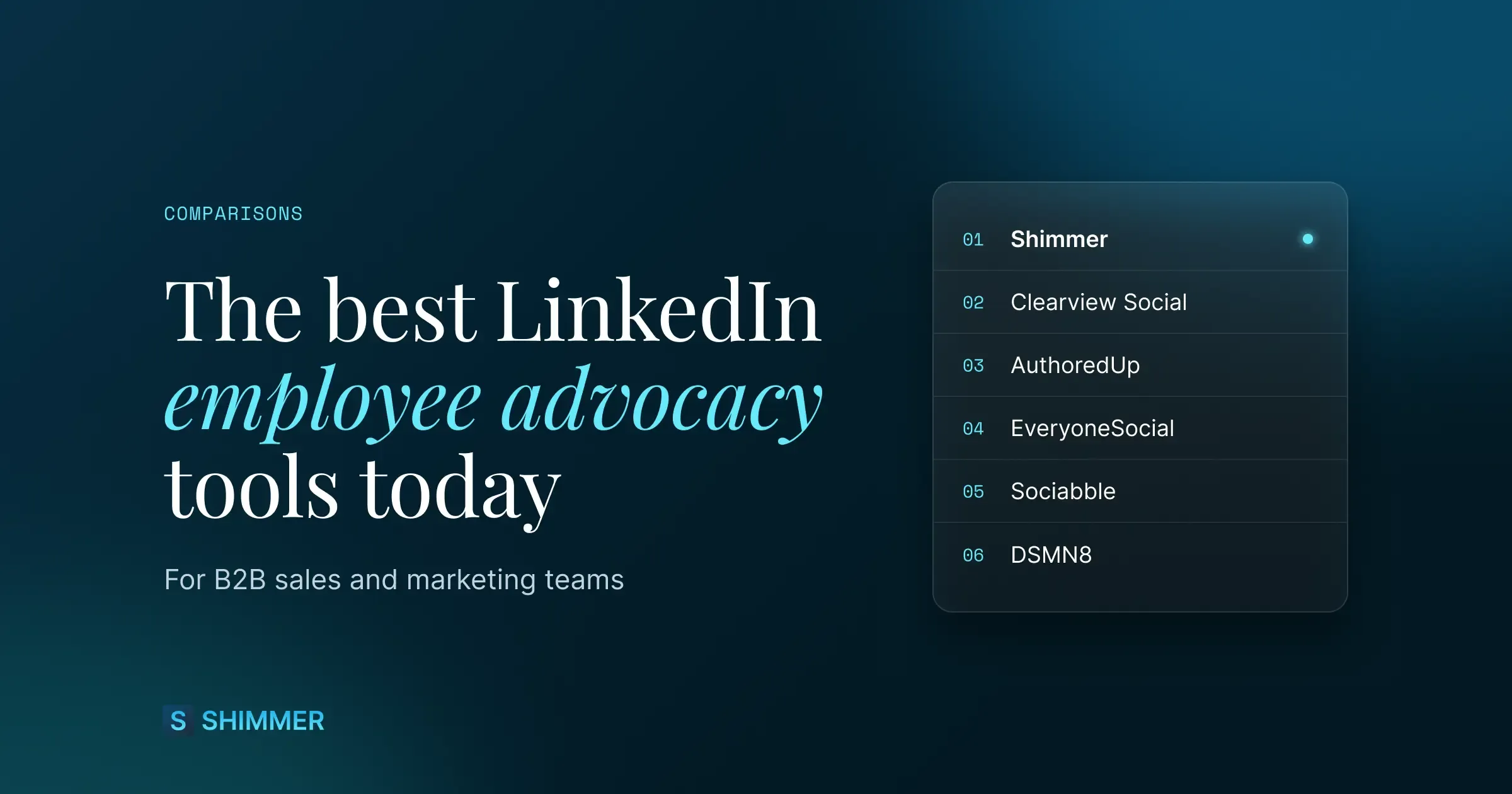
This guide covers what LinkedIn still offers natively, what to look for in a replacement, and 12 tools with pricing for each. LinkedIn-first tools come first, followed by multi-network suites for larger companies.
TL;DR
- LinkedIn removed its native advocacy features, including employee share analytics, between November 2024 and February 2025.
- Tools differ most in how they post to LinkedIn, AI caption help, and pricing.
- LinkedIn-first picks: Shimmer, Vulse, Supergrow, ClearView Social, and GaggleAMP.
- Multi-network suites: EveryoneSocial, DSMN8, Hootsuite Parliament, Sprout Social, Sociabble, Haiilo, and Oktopost.
- Published pricing starts at $99 a month for a 25-person team (Shimmer). Enterprise contracts often pass $10,000 a year.
What Happened To LinkedIn's Native Employee Advocacy Features?
LinkedIn has tried employee advocacy twice. First came Elevate, a paid mobile and desktop app that opened as a closed pilot in April 2015.
In January 2020, LinkedIn announced that core Elevate features would move into LinkedIn Pages by December 2020. Those features lived on in the My Company tab, an employee-only area of each company Page.
That second attempt ended in late 2024. LinkedIn's developer changelog lays out three steps:
- November 2024: LinkedIn began removing the My Company tab and related Page features.
- January 2025: The My Company tab, Employee Advocacy tab, and Curator role became fully unavailable. Curators were converted to Analysts.
- February 2025: The employee broadcast analytics endpoints were discontinued, so that data can no longer be exported.
So what's left?
LinkedIn's Help Center still documents Employee Notifications. These let Page admins alert employees about an important Page post, a feature LinkedIn capped at once every seven days when it launched in 2019.
Admins can also react or comment as the Page on employee posts. But there's no curated feed, no employee analytics, and no way to suggest posts to a whole team. Those gaps are what the tools below fill.
What To Look For In A LinkedIn Employee Advocacy Tool
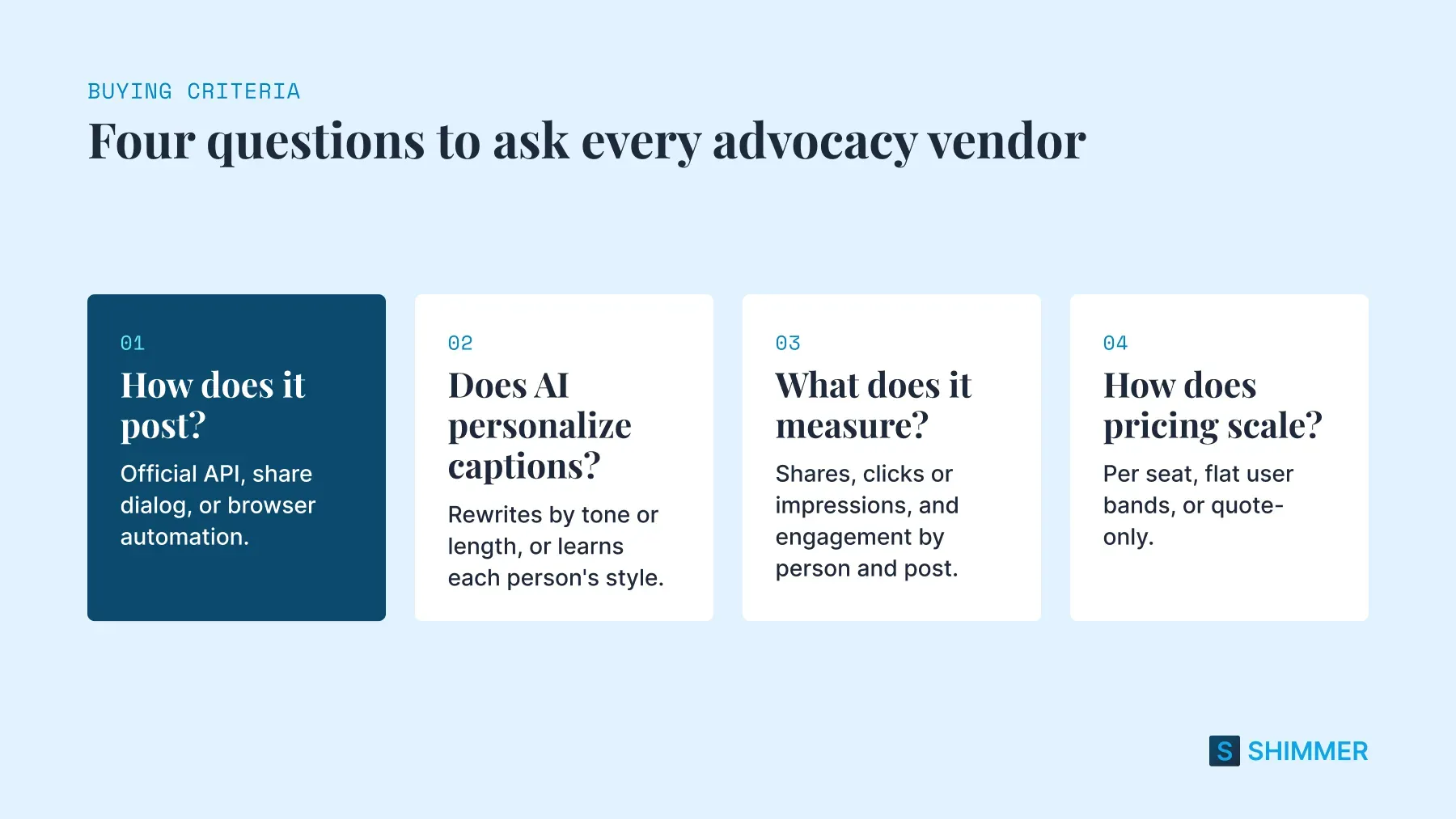
How it posts to LinkedIn
LinkedIn offers an official Share on LinkedIn API. Each employee signs in through LinkedIn's standard permission flow, called OAuth, and allows the tool to post for them. That's the route LinkedIn allows.
LinkedIn's User Agreement bans "bots or other unauthorized automated methods" for creating, liking, or sharing posts. Most vendors don't say which method they use, so ask whether it's the official API or browser automation.
AI-assisted writing
Forty identical employee posts look copied, and copied posts lose the personal voice that makes advocacy work. Look for AI that rewrites captions by tone or length, or even better, learns each person's writing style.
LinkedIn-specific analytics
LinkedIn no longer reports on employee shares, so your tool has to. At minimum, you want shares, clicks or impressions, and engagement by person and by post.
Library, adoption, and pricing basics
Marketing needs one library to load, tag, and organize approved posts. Regulated teams also need approval controls before anything goes live. Leaderboards and Slack or Teams messages help keep participation up after launch.
A per-seat plan with a 100-seat minimum is a very different bill than a flat $99 a month. For the rollout side, see Shimmer's guide to launching a LinkedIn advocacy program.
12 Best LinkedIn Employee Advocacy Tools In 2026
The tools below range from LinkedIn-only apps priced for a single sales team to enterprise suites that also run your intranet.
Use the table for a quick look at how each one posts to LinkedIn, how it helps with captions, and what it costs to start. Each tool then gets a full breakdown of its strengths, limits, setup, and pricing.
Tool | LinkedIn posting | Best for | AI caption help | Starting price |
|---|---|---|---|---|
Shimmer | Official OAuth API | LinkedIn-first sales teams | Yes (Rewriter, Evaluator) | $99/mo for 25 users |
Vulse | Official LinkedIn API | Advocacy plus inbox | Yes (tone matching) | ~$21 (£16)/mo for 1 user; ~$400 (£300)/mo for 25 users |
Supergrow | Direct publishing | Executive content | Yes (AI interviews) | $199/mo for 5 accounts |
ClearView Social | One-click and auto-posting | Professional services | Yes (captions) | $425/mo for 50 employees |
GaggleAMP | One-click activities | Directed engagement | Yes (AI Suite) | Quote (~$10,800/yr median) |
EveryoneSocial | One-click sharing | Regulated enterprises | Yes | Quote (~$28,958/yr median) |
DSMN8 | One-click sharing | AI plus gamification | Yes (Personal Voice) | Quote |
Hootsuite Parliament | One-click sharing | Hootsuite customers | Yes (AI writer) | Enterprise plan only |
Sprout Social | One-click sharing | Sprout customers | Admin-side only | Add-on, Standard+ |
Sociabble | One-click sharing | Advocacy plus intranet | Not confirmed | Quote |
Haiilo | One-tap sharing | 100+ advocates | Enterprise tier | From $15/seat/mo (~$1,500/mo minimum) |
Oktopost | Advocacy board | CRM-linked B2B | Yes (Advocacy Agent) | Quote (~$14,994/yr median) |
LinkedIn-first employee advocacy tools
The first five tools are built around LinkedIn sharing and social selling. They fit sales teams and B2B marketers who care most about LinkedIn reach.
Shimmer
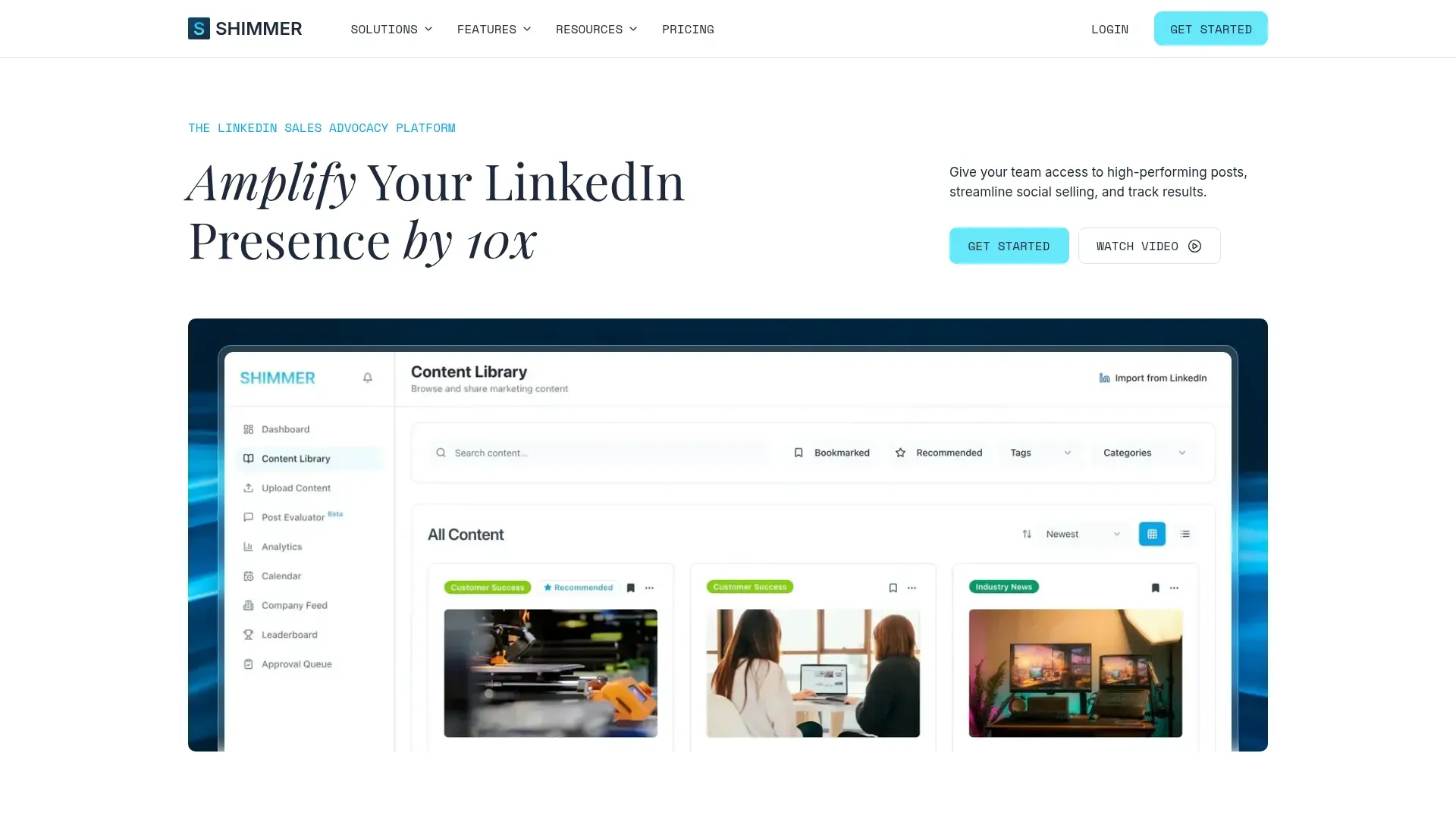
Category: LinkedIn sales advocacy platform
Shimmer is built only for LinkedIn. Marketing adds approved posts into a content library, and team members share them to their own profiles in one click. Marketing organizes the library with categories and tags and flags recommended posts, so reps know what to share first.
Reps can post right away or schedule posts on a shared calendar. A Company Feed also lets them reshare posts from the company's own LinkedIn Page.
Admins track shares, engagement, and top-performing content in one dashboard. A leaderboard ranks the team by shares and engagement, and role-based permissions keep publishing control with marketing.
Posting runs through LinkedIn's official OAuth integration, so Shimmer never stores anyone’s passwords.
Best for: B2B sales and marketing teams that want a LinkedIn-only program without an enterprise contract.
Getting started: Sign up on your own, connect LinkedIn in a few clicks through OAuth, and invite teammates with a link.
Notable feature: A Post Evaluator scores any post, and an AI Rewriter reworks it by tone, length, and focus in one click.
Limitation: It covers LinkedIn only, and there's no mobile app or approval workflow.
Pricing: Basic is $99 a month for up to 25 users. Pro is $199 a month for up to 100 users, and Enterprise is custom.
Vulse
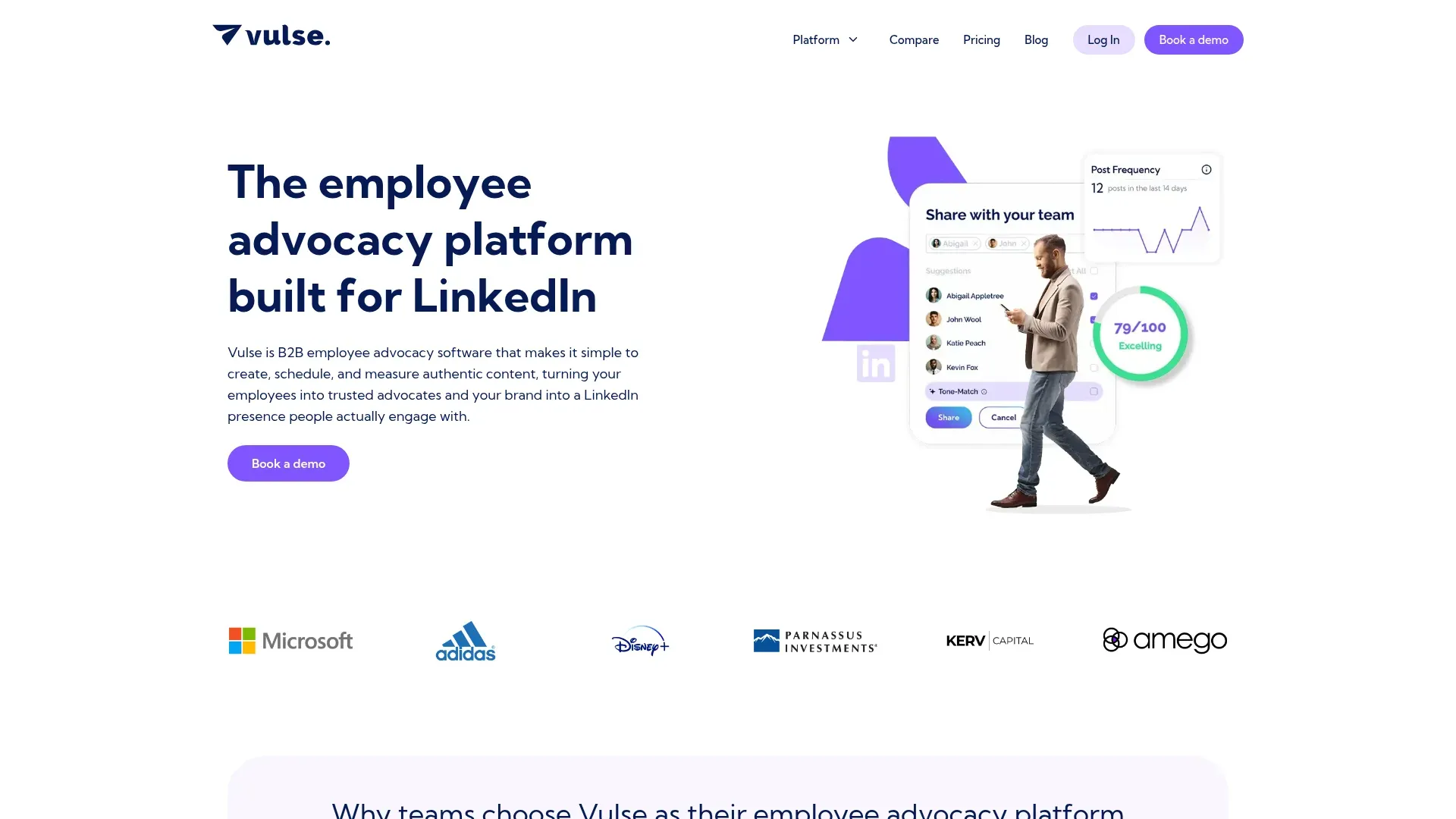
Category: LinkedIn employee advocacy platform
Vulse is another LinkedIn-only platform. It handles scheduling, approvals, and multi-profile management for personal profiles and company Pages.
Best for: Teams that want advocacy, LinkedIn replies, and API-based profile analytics in one place.
Getting started: Self-serve sign-up with no seat minimums. Every plan includes onboarding and training.
Notable feature: Tone-of-voice matching drafts first versions that fit each person's (and the brand’s) voice.
Limitation: Prices are listed in GBP only, so US buyers need a quote for exact USD rates.
Pricing: Per user per month, billed annually. It runs from about $21 (£16) for 1-10 seats down to about $7 (£5) for 100+ seats.
Supergrow
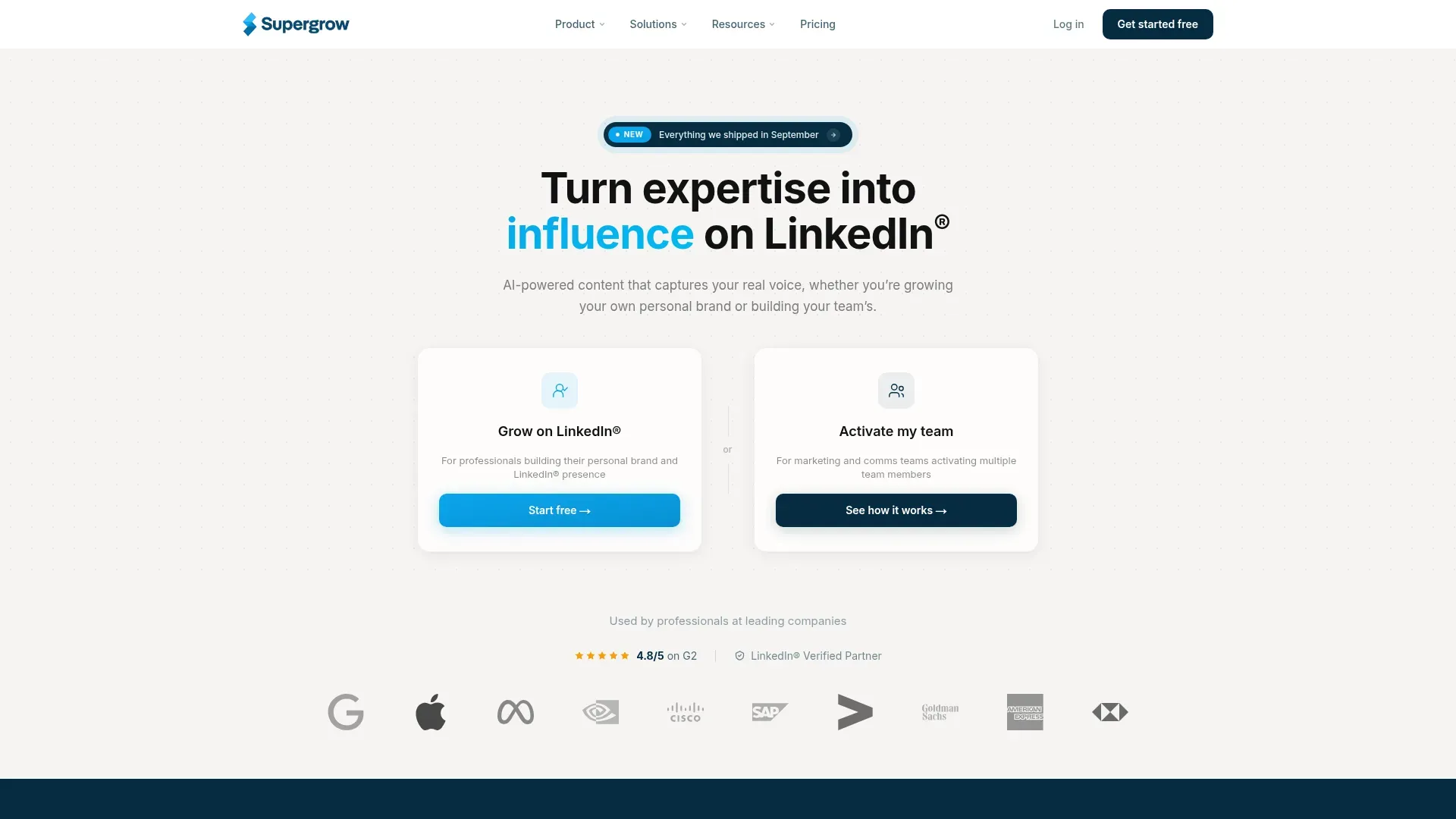
Category: AI LinkedIn content platform for executives and teams
Supergrow started as a LinkedIn writing tool and added team features. Its "Postcast" AI interviewer turns a short conversation with an executive into several drafts in their voice.
Best for: Companies whose advocacy plan depends on executives and subject experts creating original posts.
Getting started: Start a 7-day free trial without talking to sales. Team features need the Teams plan.
Notable feature: Content DNA voice profiles for each member, plus scheduling with an automatic first comment.
Limitation: Approval routing is basic. Dana, a CEO who uses it, noted on G2 that "you cannot send to two people at once for approval."
Pricing: Team features start with the Teams plan at $199 a month for five accounts. A solo Pro plan costs $39 a month, and every plan has a 7-day free trial.
ClearView Social
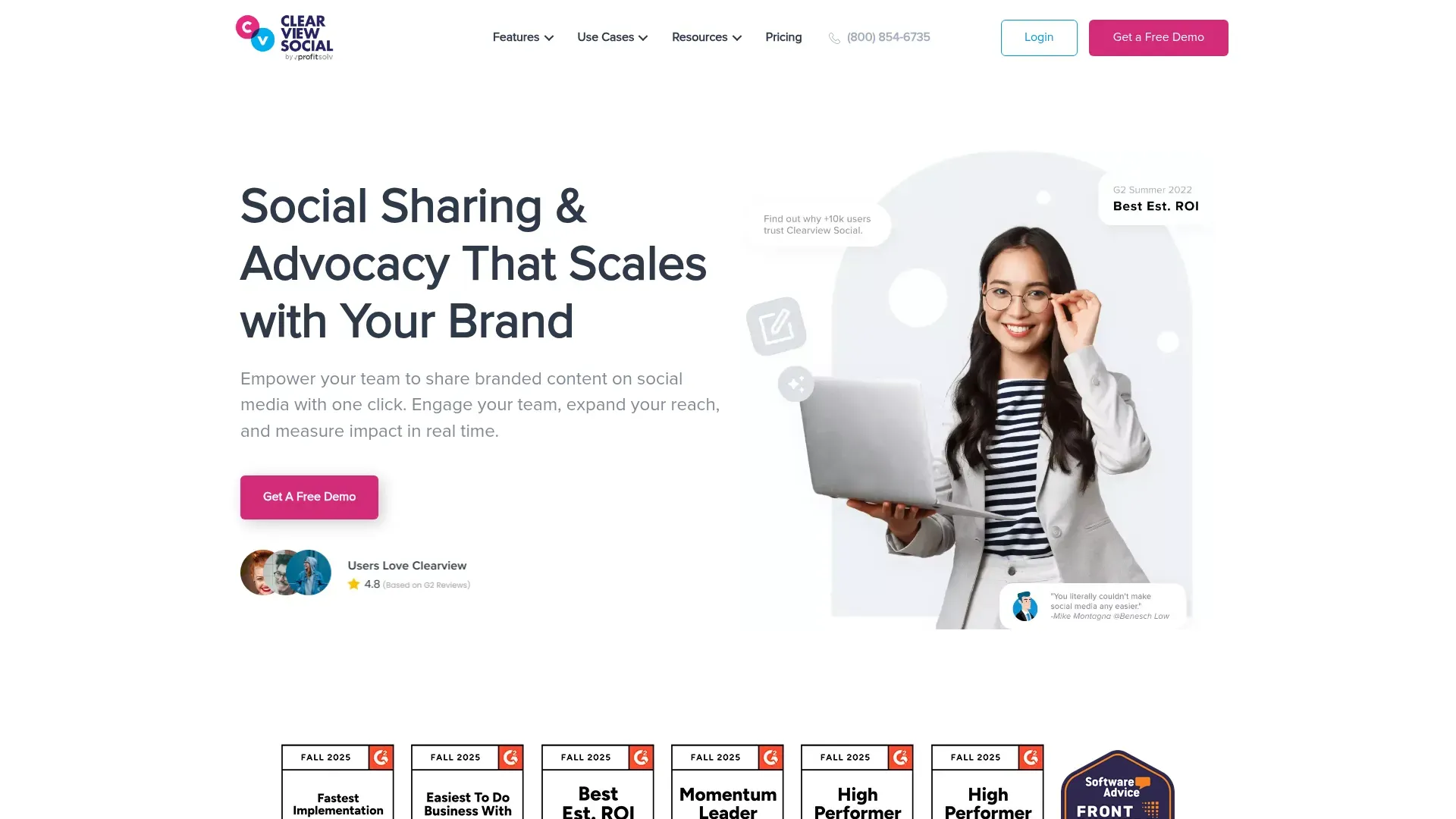
Category: Employee sharing platform for professional services firms
ClearView Social makes sharing as easy as clicking a link in an email, Slack, or Teams message. A Virtual Assistant can also post to employee profiles automatically. It covers LinkedIn, Facebook, Instagram, and X.
Best for: Law, accounting, and consulting firms where busy professionals won't log in to another app.
Getting started: Setup starts with a demo and an annual contract. After that, employees share straight from email, Slack, or Teams.
Notable feature: PeakTime AI picks the best posting time for each share.
Limitation: Contracts are annual and locked-in. Lauren, a partner at a small firm, wrote that "it really locks you in and they aren't flexible if things change!"
Pricing: Team is $425 a month for 50 employees, and Business is $675 a month for 100. Both are billed annually.
GaggleAMP
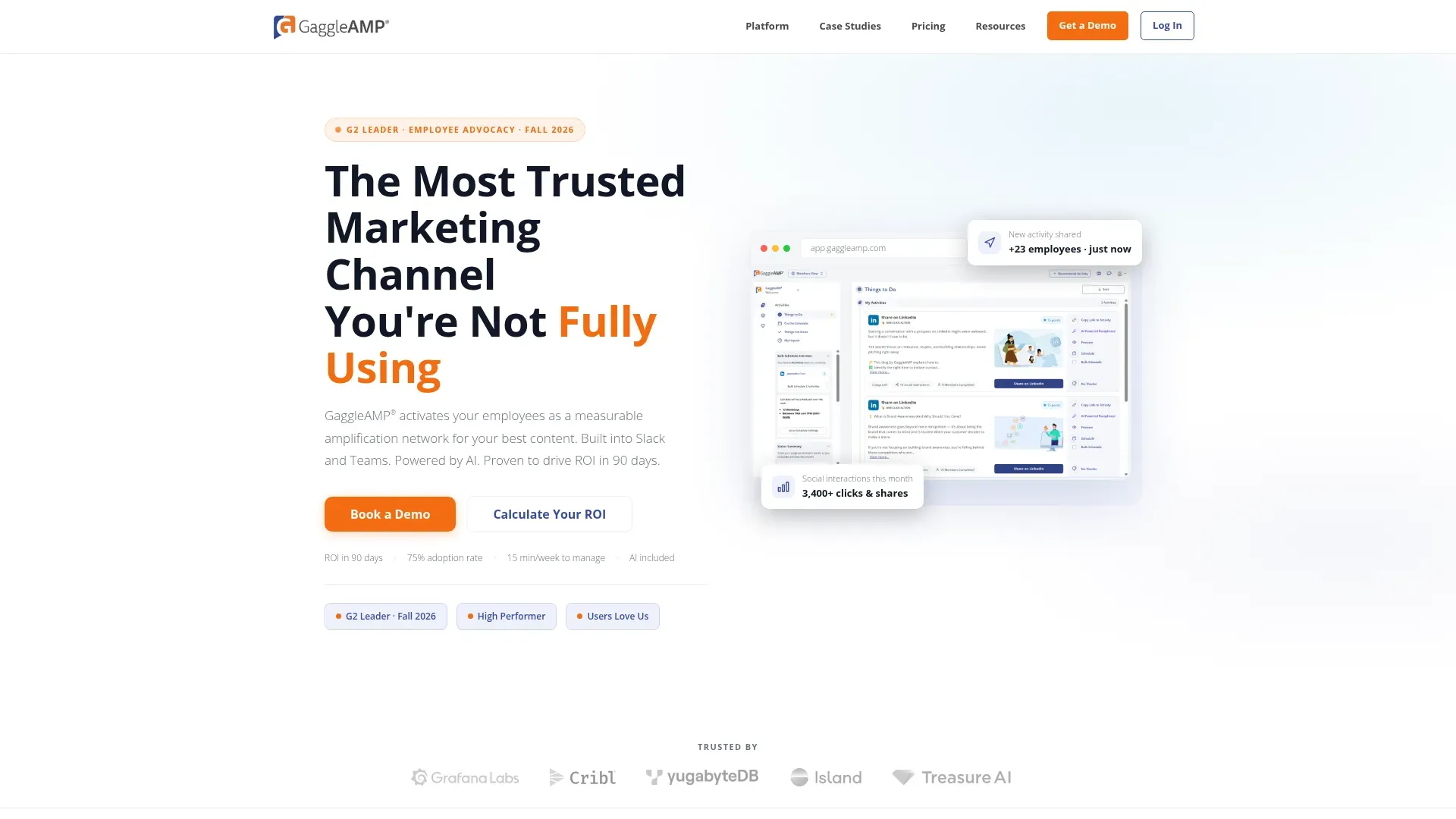
Category: Activity-based employee amplification platform
GaggleAMP assigns employees specific "activities," like sharing, liking, or commenting on a post. Its AI Suite writes a unique caption for each advocate.
Best for: Marketing teams that want to direct engagement on specific posts.
Getting started: Setup starts with a custom proposal. Employees complete activities inside Slack or Teams, and teams of 100+ get a dedicated success manager.
Notable feature: One-click activities from Slack or Teams, plus UTM attribution on employee posts.
Limitation: The mobile experience trails desktop, and some users report trouble copying and posting from their phones.
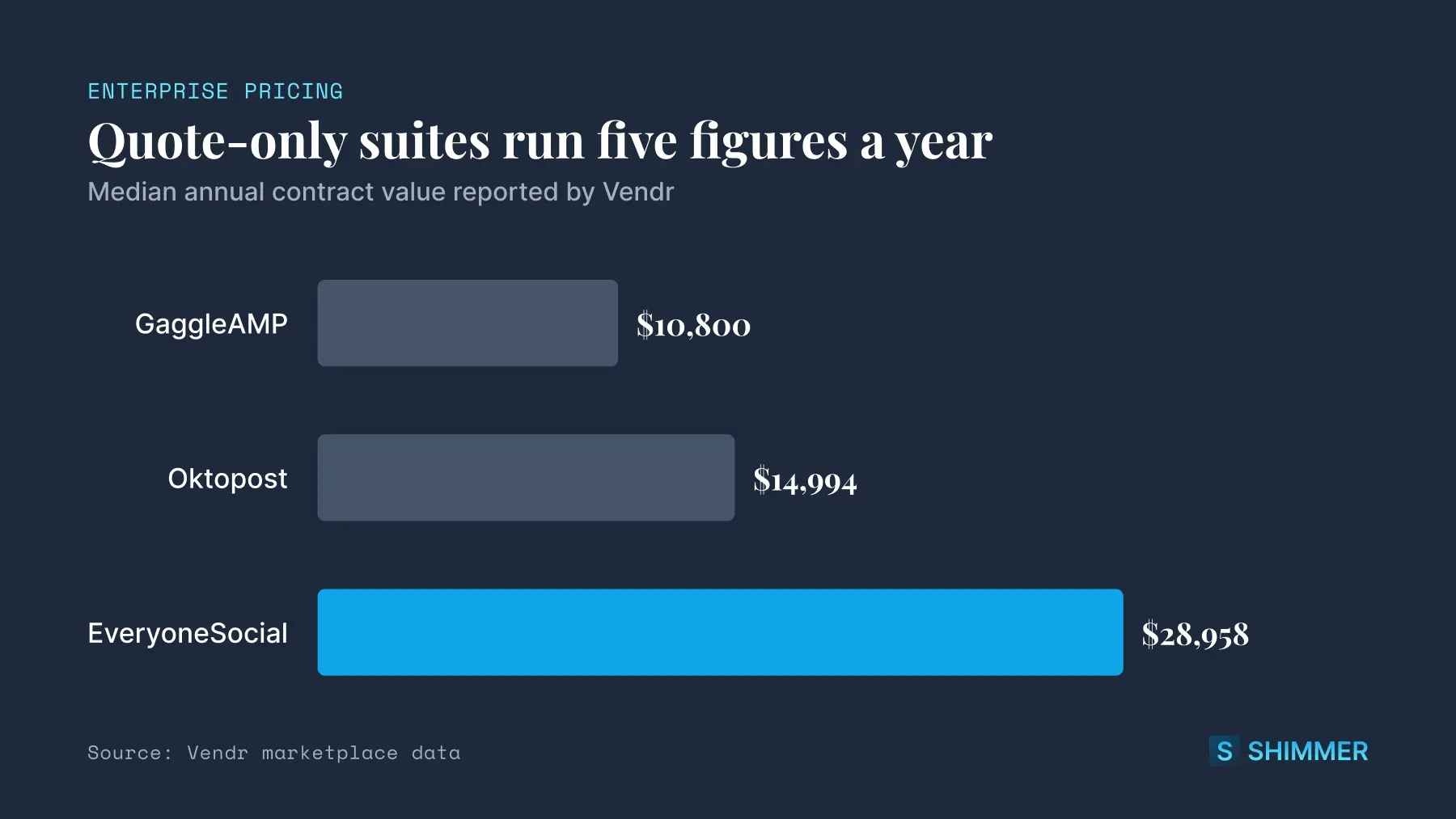
Pricing: Quote-only, priced by company size with unlimited members. Vendr puts the median contract at about $10,800 a year.
Multi-network employee advocacy suites
The next seven tools cover LinkedIn alongside other networks and internal comms. They suit larger companies with a dedicated program owner.
EveryoneSocial
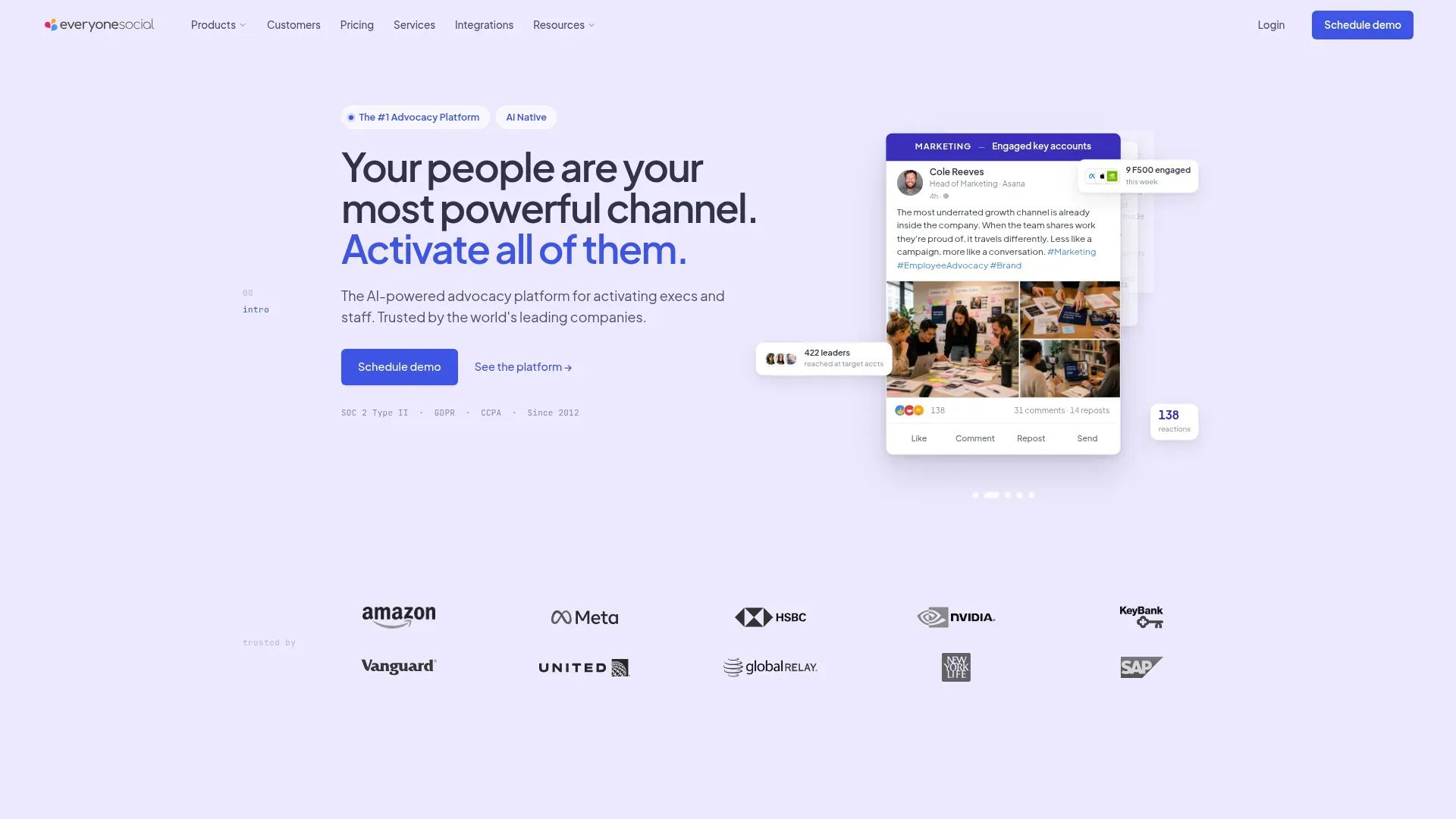
Category: Enterprise employee advocacy and social selling platform
EveryoneSocial has been around since 2012 and is built for large rollouts. It publishes to LinkedIn, X, Facebook, and Threads.
Best for: Enterprises in regulated industries that need governance, SSO, and archiving.
Getting started: Sales-led, with pilots starting at 500 people. Implementation, a dedicated success manager, and 24/7 support are included.
Notable feature: Role-based access and compliance capture for every social action.
Limitation: Pilots start at 500 people. That rules out most small teams.
Pricing: Quote-only, priced by users. Vendr reports a median contract of about $28,958 a year. For lower-cost options, see these EveryoneSocial alternatives.
DSMN8
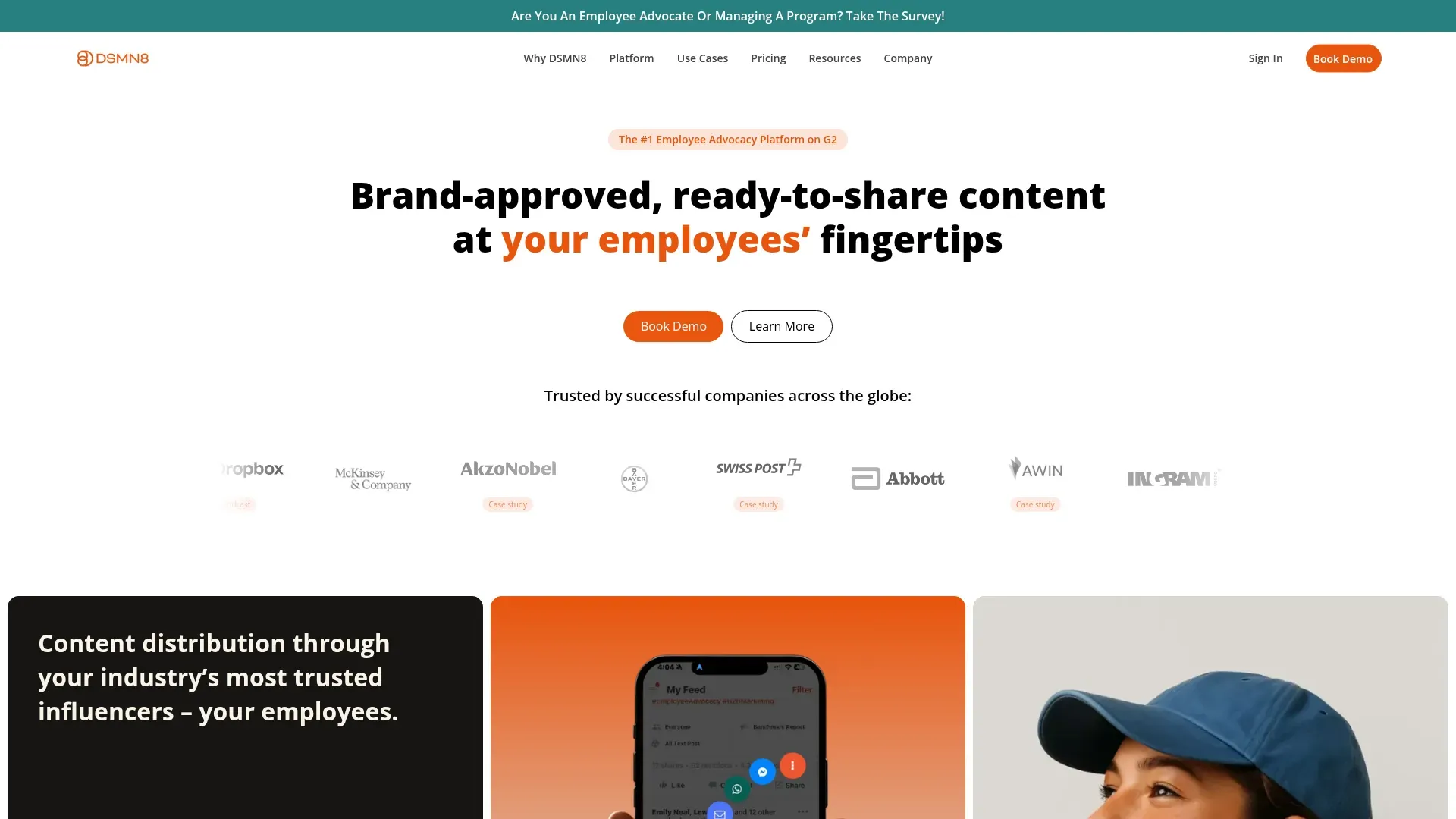
Category: Employee advocacy and executive influence platform
DSMN8 (pronounced "disseminate") lets employees edit and share approved content from a dashboard or mobile app. Its AI Content Assistant drafts captions and alternative versions of existing copy.
Best for: Mid-size and enterprise companies that want strong AI help plus gamification.
Getting started: Quote-led, with full onboarding, training, and unlimited admin seats in every package.
Notable feature: "Personal Voice" learns from an employee's writing samples and LinkedIn posts, while admin-set "Company Voice" rules still apply.
Limitation: Tagging is missing. Renata, a DSMN8 user, pointed out "I can't use the @ symbol to tag people on LinkedIn when sharing content."
Pricing: Quote-only, billed per employee on annual contracts. DSMN8 says pricing typically starts from a few dollars per employee per month.
Hootsuite Parliament
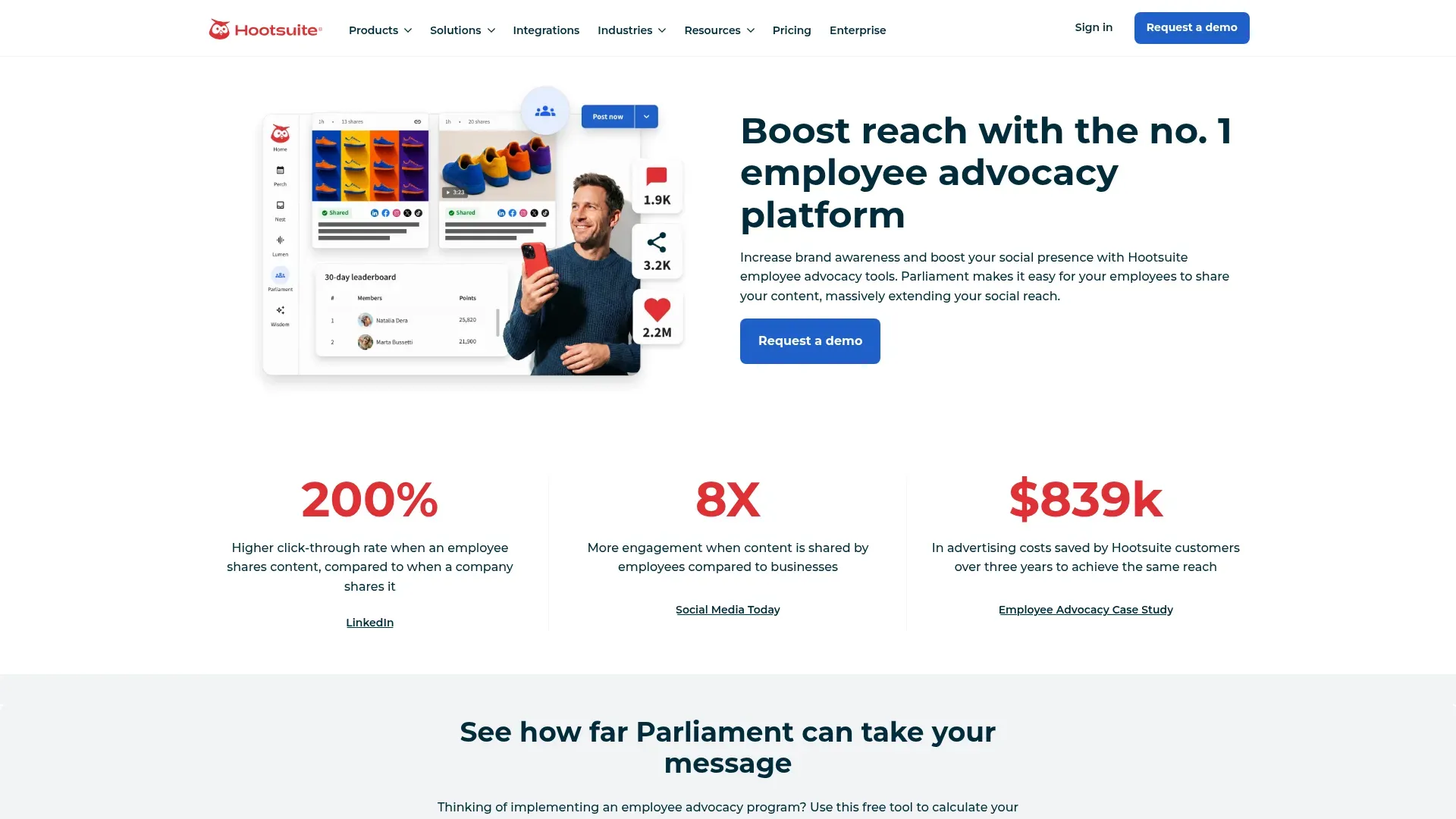
Category: Employee advocacy inside Hootsuite's social suite
Hootsuite Parliament is the new name for Hootsuite Amplify. Admins create pre-approved posts inside Hootsuite, and employees share them in a few taps. A Model Context Protocol (MCP) connector lets teams schedule shares from ChatGPT, Claude, Copilot, or Gemini.
Best for: Teams already running brand social on Hootsuite Enterprise.
Getting started: It comes only with Hootsuite Enterprise, which is custom-quoted and has no free trial.
Notable feature: An AI writer generates captions for Parliament posts.
Limitation: Hootsuite doesn't describe a dedicated mobile advocacy app, only sharing "in a few taps."
Pricing: Included with the custom-quoted Enterprise plan. Lower Hootsuite plans start at $99 per user per month but don't include Parliament.
Sprout Social Employee Advocacy
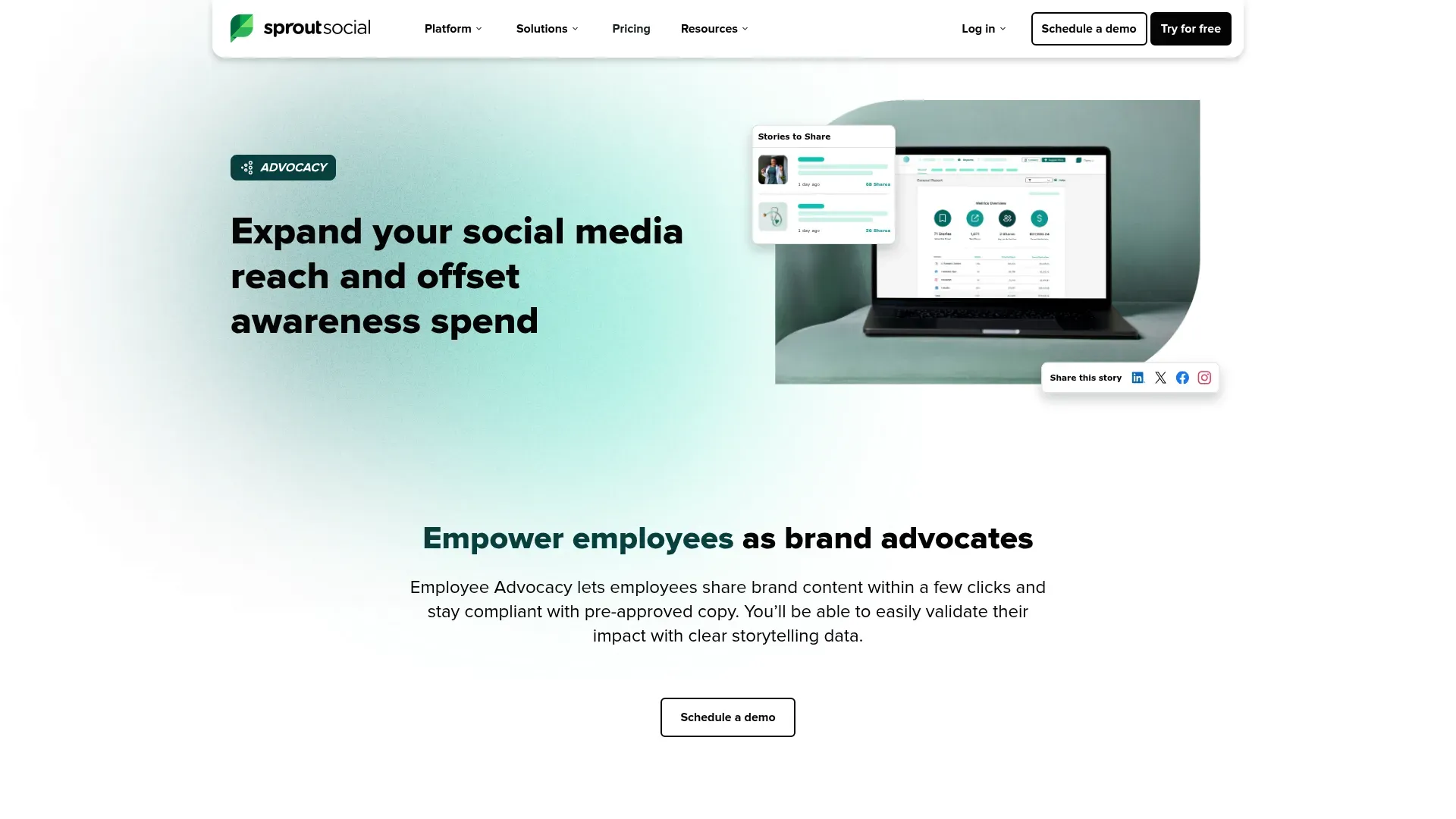
Category: Advocacy add-on for Sprout Social
Employee Advocacy by Sprout Social (formerly Bambu) lets employees connect their LinkedIn profile and share in one click. Admins can push brand posts from Sprout's Compose workflow into the advocacy feed.
Best for: Marketing teams already on Sprout Social Standard or higher.
Getting started: Sprout's base plans have a 30-day free trial, but the advocacy add-on goes through a demo.
Notable feature: UTM tracking and earned media value calculations tied to each share.
Limitation: AI Assist suggests message ideas when an admin creates a story. It doesn't rewrite posts for each employee.
Pricing: The add-on price isn't published. It requires at least the Standard plan at $199 per seat per month.
Poppulo (formerly Sociabble )
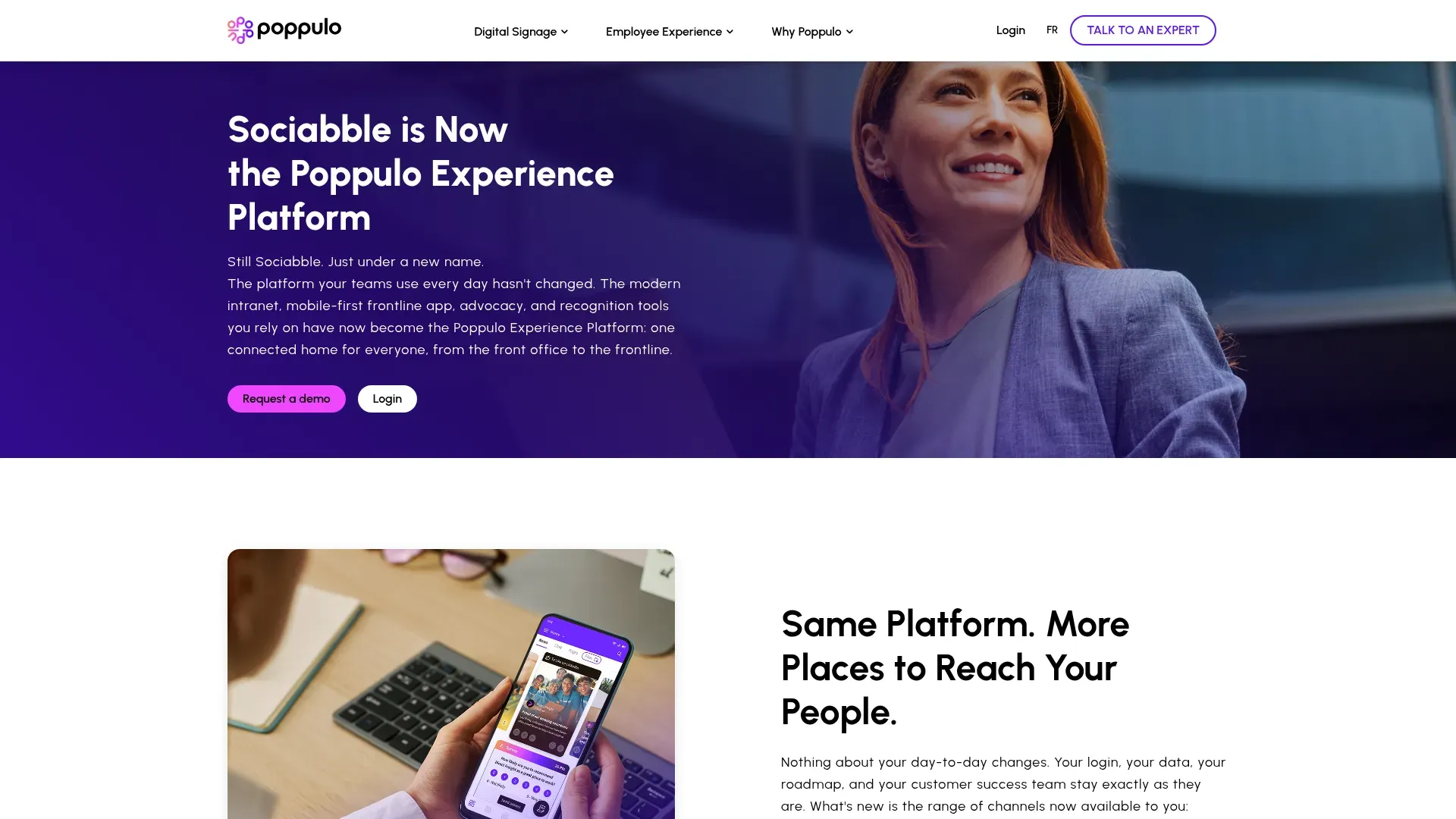
Category: Advocacy, intranet, and internal comms platform
Sociabble combines employee advocacy with a social intranet, a frontline mobile app, and recognition tools. Poppulo acquired Sociabble in May 2026, and it's now sold as part of the Poppulo Experience Platform.
Best for: Large companies that want advocacy and internal communications in one hub.
Getting started: A guided rollout, with consulting days and admin and user training included in every pack.
Notable feature: Content reaches employees through the mobile app, email, intranet, Teams, or Slack.
Limitation: It's a big platform to run. Nour, an IT project lead, said that "some advanced configurations and administrative tasks can be complex."
Pricing: Custom, in packs sized by user count. Compare options in this Sociabble alternatives guide.
Haiilo
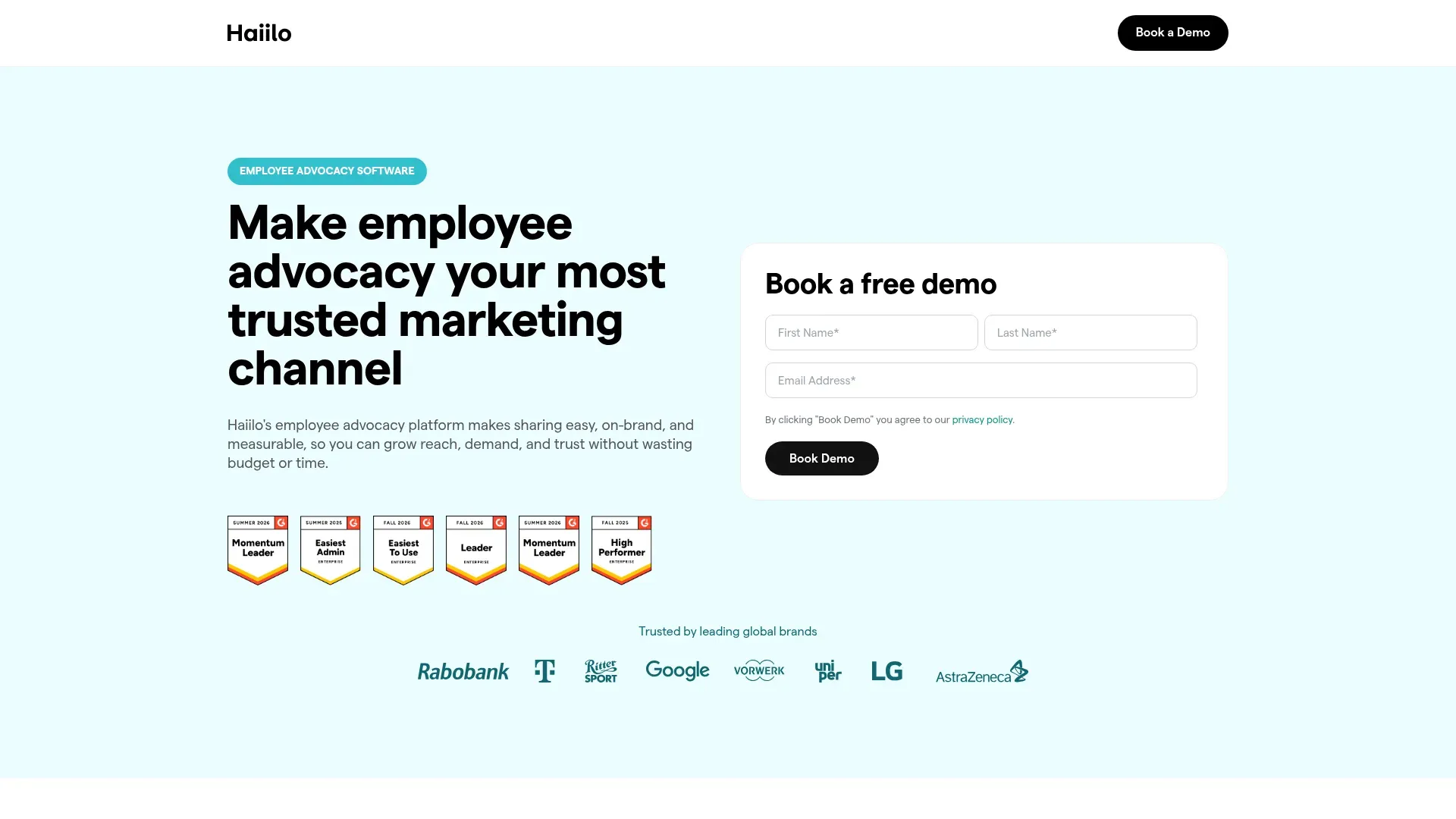
Category: Employee advocacy and intranet platform
Haiilo offers one-tap sharing from a mobile advocacy app, plus email digests and unlimited content channels.
Best for: Companies with 100+ advocates that want a published starting price.
Getting started: Starter needs at least 100 seats, and Haiilo doesn't mention a free trial.
Notable feature: LinkedIn impressions analytics and Smart Share timing on higher tiers.
Limitation: AI writing help and Slack or Teams sharing are Enterprise-only.
Pricing: Starter is from $15 per seat per month. Haiilo's pricing page lists both a 100-seat and a 150-seat minimum. That puts the floor at about $1,500 to $2,250 a month.
Oktopost
Category: B2B social media management with built-in advocacy
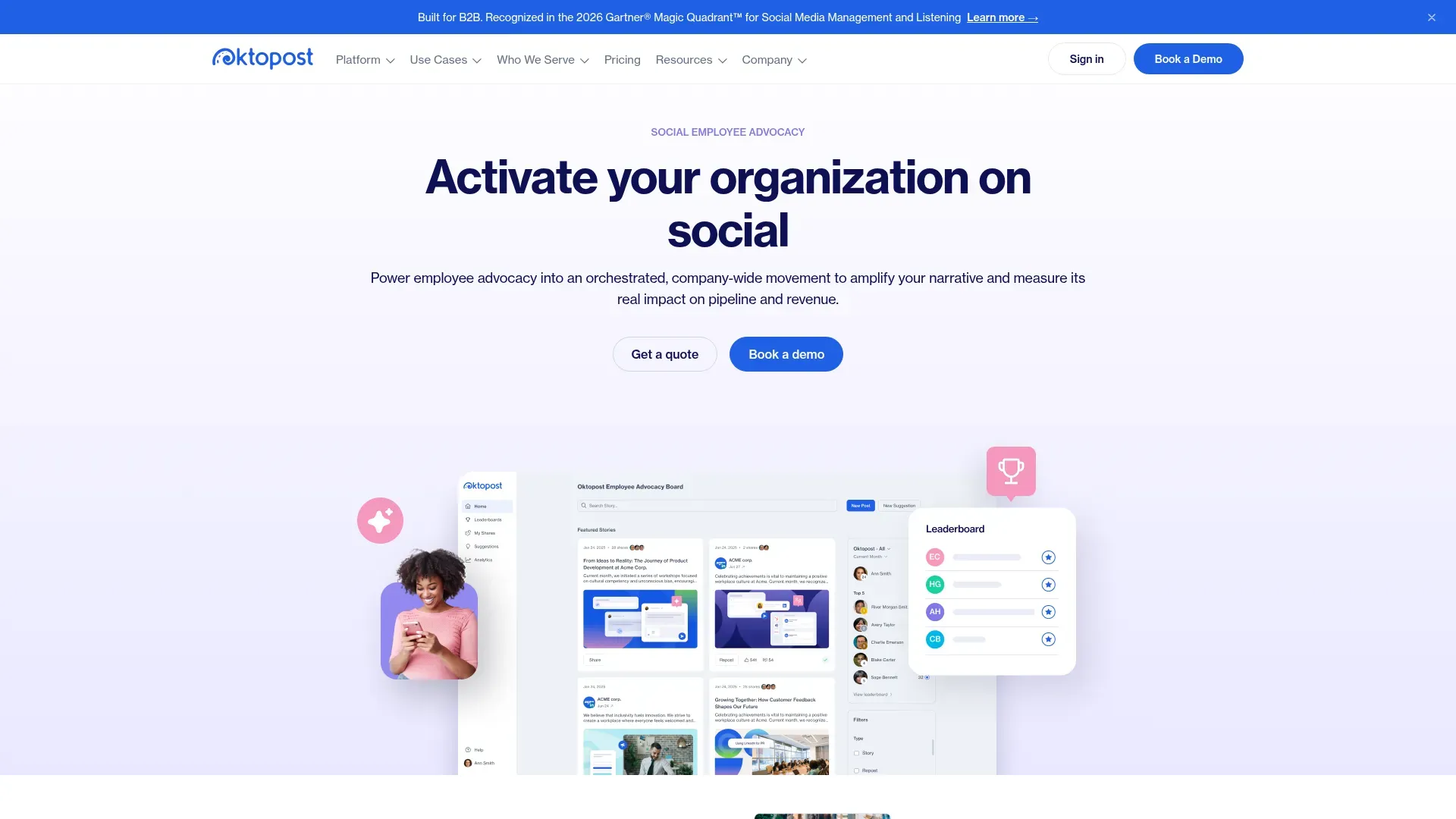
Oktopost pairs social publishing and listening with an advocacy board employees share from. Its Advocacy Agent turns approved content into post suggestions matched to each employee's voice profile.
Best for: B2B marketing teams that want advocacy tied to CRM data.
Getting started: Quote-based annual plans. Advocacy is set up inside Oktopost's wider social suite.
Notable feature: Social Signals connects employee-driven social actions to leads, accounts, and opportunities in Salesforce.
Limitation: It's a full social suite, so teams that only need advocacy pay for more than they use.
Pricing: Quote-only, on annual plans. Vendr reports a median contract of about $14,994 a year for the whole platform.
How Much Do LinkedIn Employee Advocacy Tools Cost?
Pricing varies more than features in this category. The same 25-person team could pay $99 a month or sign a five-figure annual contract, depending on how the vendor charges.
Common pricing models
Most tools use one of four models:
- Flat team tiers: One monthly price covers a band of users. Shimmer charges $99 a month for up to 25 users, and ClearView Social charges $425 a month for up to 50 employees.
- Per-seat pricing: You pay for each employee who joins. Vulse runs about $7 to $21 per user per month with no seat minimum, and Haiilo starts at $15 per seat with a 100-seat minimum.
- Add-ons to a social media suite: Advocacy is sold on top of a larger plan. Sprout Social's add-on needs at least the Standard plan at $199 per seat per month, and Hootsuite Parliament comes only with Hootsuite Enterprise.
- Quote-only enterprise contracts: EveryoneSocial, GaggleAMP, DSMN8, Sociabble, and Oktopost price by company size or seat count on annual contracts.
What to expect to pay
For a 25-person team, published prices start at $99 a month with Shimmer and about $400 (£300) a month on Vulse's annual plan. ClearView Social starts at $425 a month, which covers up to 50 employees. Enterprise suites usually run five figures a year, as the chart below shows.
Watch for costs beyond the sticker price. Haiilo's 100- to 150-seat minimum puts its floor at about $1,500 to $2,250 a month. ClearView Social and most enterprise suites bill annually, and Sprout's add-on sits on top of a $199-per-seat base plan.
Source: Vendr marketplace data
Why Shimmer Is Built For LinkedIn-First Sales Teams
Shimmer is built for teams whose buyers live on LinkedIn. It fills the gaps LinkedIn left in 2024 with a curated content library, a team leaderboard, and analytics on shares and engagement. The AI Rewriter keeps 40 reps from posting the same caption.
For marketing, that means one place to manage what the team shares. Posts live in a library with categories, tags, and LinkedIn-style previews, and marketing can recommend posts for reps to share. When new content is recommended, Shimmer can notify the team in Slack or Microsoft Teams.
For reps, sharing takes seconds. They can post in one click, schedule posts on a shared calendar, or reshare the company page's latest updates from the Company Feed. The Post Evaluator scores a draft and suggests a stronger rewrite before it goes out.
For leadership, the program finally has numbers. Admins see weekly shares, active reps, engagement rate, and top-performing content (the reporting LinkedIn stopped providing). Posting runs through LinkedIn's official OAuth connection, so reps never provide their passwords and they can revoke access at any time.
Pricing is flat by team size. A 25-person team pays $99 a month, less than one Sprout Social Standard seat. Start your free Shimmer trial to see it with your own content.
FAQ
Does LinkedIn still have a built-in employee advocacy tool?
No. The My Company tab, Employee Advocacy tab, and Curator role were removed between November 2024 and January 2025. Page admins can still send Employee Notifications, but there's no curated feed or employee analytics.
What happened to LinkedIn Elevate?
Elevate launched as a paid app in 2015. LinkedIn moved its core features into Pages by December 2020, and those Page features were removed in the 2024 change.
Are employee advocacy tools allowed under LinkedIn's terms?
Tools that post through LinkedIn's official API work within its rules. Each employee authorizes the app through OAuth. LinkedIn bans bots and unauthorized automation for posting, liking, and sharing, so ask vendors how they post.
How much do LinkedIn employee advocacy tools cost?
Published pricing starts at $99 a month for 25 users (Shimmer), and per-seat tools like Vulse run about $7 to $21 per user per month. Enterprise suites are usually quote-only. Median contracts reported by Vendr run from about $10,800 to $29,000 a year.
What are some effective tools for employee advocacy on LinkedIn?
Shimmer, Vulse, and Supergrow suit LinkedIn-first teams. EveryoneSocial, DSMN8, and Sociabble suit large multi-channel programs.
What is the 4-1-1 rule on LinkedIn?
The 4-1-1 rule was popularized by Tippingpoint Labs and Content Marketing Institute founder Joe Pulizzi. For every self-promotional post, share four useful pieces from others and one re-share.
What is the 3/2/1 rule on LinkedIn?
There's no official version. It's an informal rule of thumb, most often described as three value posts, two engagement posts, and one promotional post.
How do you measure employee advocacy on LinkedIn without native analytics?
Use your advocacy tool's reports for shares, clicks, and engagement by person and post. Add UTM tags to shared links so traffic and leads show up in your analytics and CRM. Track participation monthly, because adoption is usually the first number to slip.